

Ken Sakata, of Front Office, is now on Substack. I love his content. He’s a great fashion historian and theorist and practitioner, and I would like own one of his pieces one day.
One of his recent posts defined strata of sexiness: Vulgarity, eroticism, and sensuality, using the way clothing hangs on a body. Vulgarity: Nothing is left to the imagination. It’s just out there. Eroticism: There’s a tension and a pressure inherent in it: You’re not allowed to see a thing, even though you really want to. Sensuality: It’s about what Sakata calls “first-person fashion”: it’s about how the body experiences itself. In design terms, you’ll see shapes that only hint at the body beneath, if at all.
This is an excellent primer for writers, too. If you’re wanting to write sexy, I’d consider using Sakata’s breakdown here as a guideline.
In the MFA program I teach in, the powers that be are fighting against AI, tooth and nail. I don’t love this. AI is here to stay, we instructors need to be teaching our students about using it responsibly—and towards more of their own creativity.
I ran across this great post from mathematician Hannah Fry. In it, she talks about how to use AI. I can’t find the Instagram link, but here’s the ugly Facebook link, which for some reason isn’t populating here.
Briefly: Prompt it as if you want it to play a role, because large language models don’t generate responses as a fixed worldview with a stable identity. They’re just scooping from a gazillion different personalities.You know the actor Doug Jones from his turns as the amphibian man in The Shape of Water and Joey in Men in Black.
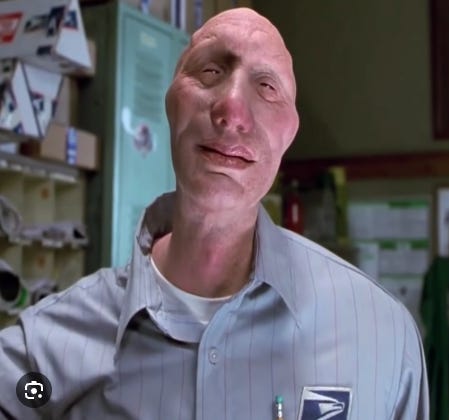
He’s almost always in heavy makeup.
Anyway! He has a new YouTube series out that just calls to me. It’s called Stop the Car, and it’s about all the tiny museums you only ever see on road trips.
I love these museums, and I’m excited to dig into Jones’s new series. Among my favorite small museums/places to go is Coupeville, WA’s Island County Historical Museum, and also every municipal museum ever. I also like to stop at any brown sign on the highway.
For the past few weeks or so, I’ve been in a funk. I’m a lifelong exerciser, but I haven’t done anything beyond walking the dog since a rock-climbing trip in late October. No matter how many words I put down on the page, I can’t see a world in which I ever complete another book. I’m really stressed, and I think it’s because my caregiving duties and their attached attention-drawing things are weighing on me.
It occurred to me that when we try to show we care about our friends who are caregivers, whose close relatives are undergoing health issues, we ask, “How’s your mom/dad/uncle/aunt?” We almost never, ever start by asking, “How are you?”
This is a thing that has struck home recently. A well-meaning relative asked how he could support my parents, and by doing so, support me. When actually, it’s the other way around: By supporting me, you can support my parent.
Because I am in bad shape, people. Things are not good. I’m working through it. It’ll be fine.
But I can’t give good care if I’m not taking care of myself, and knowing that people are wondering how I am is helpful.Related to that, I had a pretty bad day a couple of weeks ago, and I had more than one person say to me, “You’ll get over it” and “it’s just a phase.” People. This is not the right thing to say to someone having a bad day. The right thing to say is, “How much cake/ramen would you like?” and “How can I help?” Or nothing. Nothing at all is good, too, and just sitting with a person.
I use my library a lot. I use it as a place to go work when I need a change of scenery, or when I’m meeting up with a friend for a writing date. But I have never used it to borrow cookbooks, as Jenna Helwig suggests in her note:
What a great idea! I’ve been actually divesting of my cookbooks, and I’ll confess I’ve been feeling sad about all the recipes I won’t get to try. This solves my problem—and gets me more time in my library. <3
I’m finally reading Butter, by Asako Yuzuki, on rec from a friend.
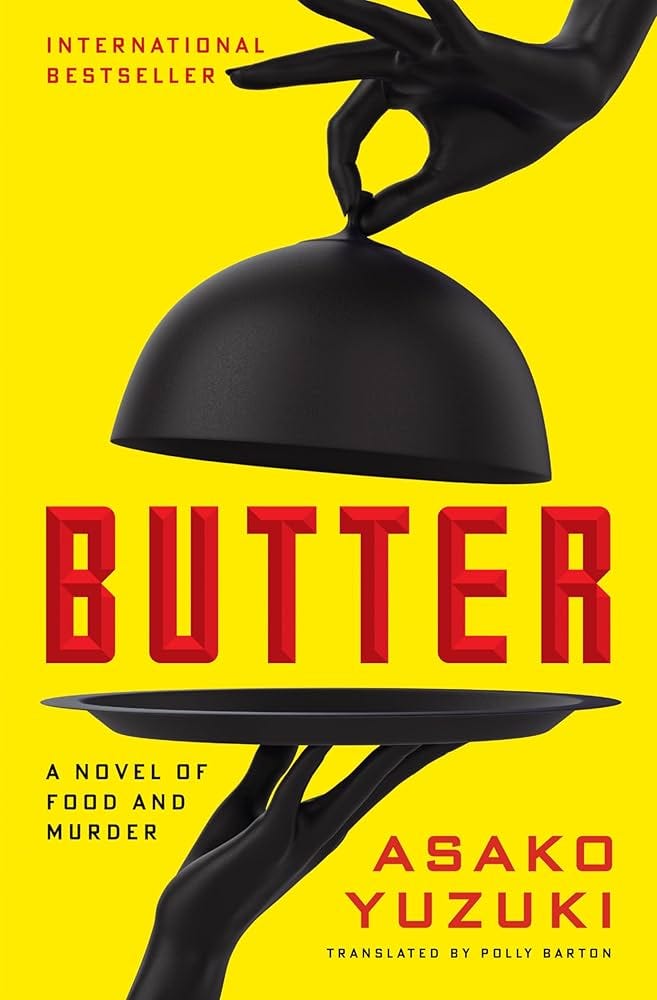
One of the things I’m really enjoying about this book is how interior the characters are. We get so much internal thought from the heroine and her friend, and those interior lives are so rich. Worth a read, for sure, and I can’t wait to see what happens.
That’s it for this week, folks. See you again next time.
Sending you a big hug.
2025 has been a scorched-earth, humanity’s colon cleanse, year. It’s been a lot for a lot many people.
Wish I could bring you ramen, friend. Or cake.